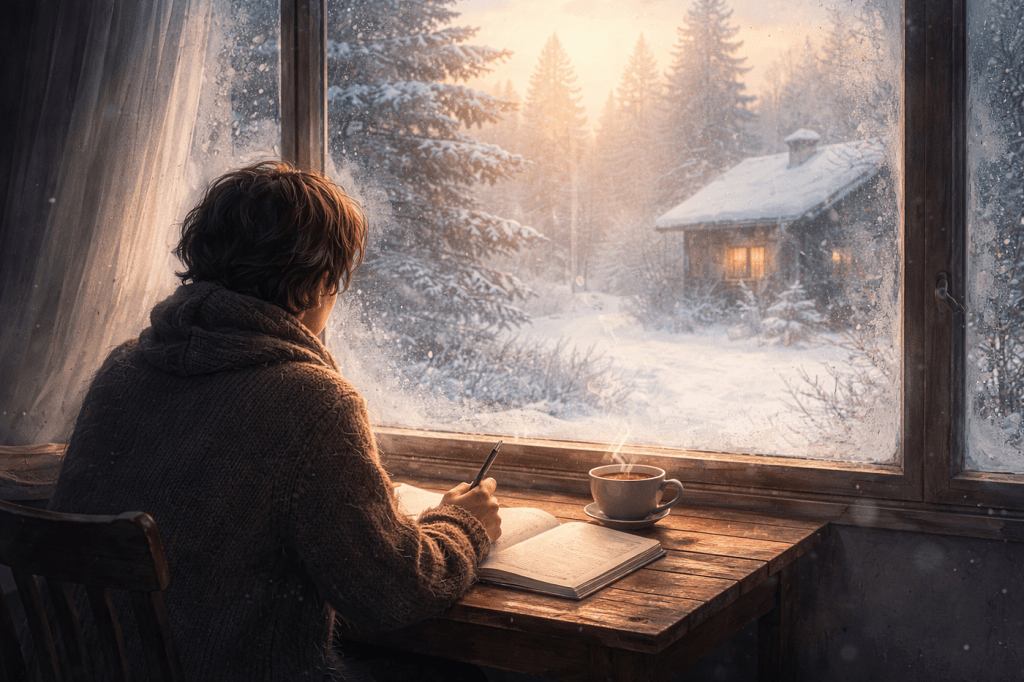
2026, February 2026

A 5-Minute Writing Check-In for February

February doesn’t usually arrive loudly.

It doesn’t burst in with fireworks like January. It doesn’t demand reinvention.
It feels quieter. Softer. A little more honest.

And that’s exactly why this is the perfect time for a 5-minute writing check-in.

Not a performance review.
Not a guilt spiral.
Not a “why haven’t I done more?” conversation.

Just five minutes to sit with your creative self and ask:

Where am I right now?


🌿 Minute 1: How Do I Feel About Writing Today?

Before you think about word counts or unfinished drafts, pause.

Ask yourself:

  • Am I excited?
  • Tired?
  • Avoiding something?
  • Curious?
  • Burned out?
  • Quietly hopeful?

There is no wrong answer.

February energy often feels reflective. Slower. Especially if January felt overwhelming.

Let yourself name the feeling without trying to fix it.


🖊️ Minute 2: What Am I Carrying?

Sometimes we aren’t blocked.

We’re just carrying too much.

Write one sentence to complete this:

“Right now, writing feels heavy because…”

Or:

“Right now, writing feels light because…”

You might discover:

  • You’re putting too much pressure on yourself.
  • You’re excited about a new idea.
  • You’re afraid to finish something.
  • You’re protecting a story that feels vulnerable.

Awareness changes everything.


✨ Minute 3: What Small Thing Would Feel Good?

Not productive.

Not impressive.

Just good.

Maybe:

  • Opening your draft and rereading one page.
  • Brainstorming names for a side character.
  • Writing 100 messy words.
  • Journaling about why you started this story.
  • Designing a tiny mood board.

Small counts. Small builds trust.

If you’re managing chronic illness, stress, or burnout (like many of us are), small is not “less.” Small is sustainable.

And sustainable writing is powerful.


❄️ Minute 4: What Is This Season Teaching Me?

Winter has a way of slowing everything down.

Even if you don’t have snow where you live, there’s still a quiet undercurrent this time of year.

Ask yourself:

  • What is this slower season revealing about my creative pace?
  • What expectations am I ready to release?
  • What do I want to nurture instead of force?

February is not about starting over.
It’s about adjusting gently.


🔥 Minute 5: One Soft Commitment

End your check-in with one soft promise.

Not a rigid goal.

A gentle direction.

For example:

  • “I will write twice this week for 10 minutes.”
  • “I will focus on character development instead of word count.”
  • “I will let this draft be messy.”
  • “I will rest without guilt.”

Write it down.

And let that be enough.


Why This Matters

We’re often taught to measure writing by output.

But writing is also a relationship.

With your ideas.
With your body.
With your seasons.

February is a beautiful time to tend that relationship quietly.

Not with pressure.

With presence.


A Gentle Closing Question

If you only wrote one paragraph this month, but it felt honest—
would that be enough?

Maybe February isn’t asking you to produce more.

Maybe it’s asking you to listen more.

And five minutes is enough to begin.

Happy Writing ^_^

2026, February 2026

Snow as a Liminal Space: Between Rest and Awakening

Snow has always felt like a pause between breaths.

It isn’t quite sleep, and it isn’t quite movement forward. It’s a threshold—a liminal space where the world softens, quiets, and holds itself still just long enough for something to shift underneath.

When snow falls, everything changes without actually ending. Roads disappear. Familiar shapes blur. Sound dampens. Time feels slower, almost suspended. And in that quiet, we’re invited into a space that isn’t about productivity or urgency—but about being between.

The In-Between Season

Liminal spaces are places of transition: doorways, dawn, dusk, endings that haven’t yet become beginnings. Snow belongs here. It covers what was, without erasing it. The ground is still alive beneath the frost, roots still holding, seeds still waiting.

This is what winter teaches us: rest doesn’t mean stagnation.

Snow asks us to trust the unseen work happening below the surface. The soil is preparing. The trees are conserving. The world is not asleep—it’s gathering itself.

Writing in the Snow-Quiet

For me, snow shifts how I write.

I don’t reach for urgency or big revelations. I write softer. Slower. My words become observational instead of declarative. Snow encourages reflection rather than answers—questions that don’t need to be solved yet.

This kind of writing feels like sitting beside a window, notebook open, watching flakes fall and letting thoughts drift in and out without pressure. It’s not about finishing something. It’s about listening.

Snow gives permission to write unfinished things.

Fragments. Half-formed images. Feelings without conclusions.

Rest That Isn’t the End

There’s a cultural pressure to treat rest as something earned—or worse, something temporary until we can get “back on track.” Snow doesn’t follow that logic. It arrives when it arrives. It stays as long as it needs. And when it melts, the world is often quieter, cleaner, ready.

Rest in winter isn’t failure. It’s preparation.

Snow reminds us that awakening doesn’t always look loud or dramatic. Sometimes it looks like stillness. Sometimes it looks like patience. Sometimes it looks like trusting that movement will come back in its own time.

Standing at the Threshold

If you’re in a season that feels quiet, heavy, or uncertain, snow offers a gentle truth: you are not behind. You are between.

Between what you were and what you’re becoming.
Between exhaustion and renewal.
Between holding on and opening up.

And that space—fragile, hushed, liminal—is not something to rush through.

It’s something to stand inside, breathe in, and let shape you.

Happy Writing ^_^

2026, February 2026

Three Things Winter Helped Me See More Clearly

Winter has a way of slowing everything down—whether we want it to or not. The shorter days, the colder air, the quiet that settles in after snowfall… it all creates space to notice things we might rush past the rest of the year.

This winter, especially, asked me to pause. To look honestly at where I am, what I’m working toward, and what simply needs more time. Here are three things winter helped me see more clearly.

1. Some goals are meant for now, others are meant for later

Winter showed me that not every goal needs to be chased at full speed. Right now, my focus is on steadiness—supporting my health, protecting my energy, and building my life in ways that don’t demand more than I can give.

There are goals I’m holding gently in the present: continuing my writing, growing my business slowly, staying connected to what brings me meaning. And there are goals that belong to the future—bigger plans, long-term dreams, things that will unfold when my body and life are ready.

Winter reminded me that postponing something doesn’t mean abandoning it. It just means honoring timing.

2. Healing and change take longer than we want—and that’s okay

Winter doesn’t rush. Snow doesn’t ask permission before it falls, and it doesn’t melt the moment we want it gone. It takes its time, responding to warmth when it comes.

Living with ongoing health challenges has taught me the same lesson. Some things won’t resolve quickly, no matter how much effort or hope I pour into them. Winter helped me release the pressure to “fix” everything at once and instead focus on care, patience, and small, consistent steps.

Progress doesn’t always look dramatic. Sometimes it looks like rest. Sometimes it looks like survival. Sometimes it looks like choosing kindness toward myself on hard days.

3. What remains after the snow melts is what matters most

Watching the snow fall—and later disappear—reminded me that even when something beautiful fades, what’s underneath is still there. Life keeps going. The important things don’t vanish just because a season ends.

After the snow melts, what’s left are the things worth tending to every day: moments of peace, creativity, connection, presence. Winter encouraged me to enjoy what’s in front of me instead of constantly waiting for the next milestone or “better” season.

Each day holds something worth noticing, even if it’s small. Even if it’s quiet.

Happy Writing ^_^

2026, February 2026

February Didn’t Start Loud—It Started Quiet

February didn’t arrive with fireworks or declarations.
It didn’t knock on the door or demand change.

It came quietly.

With slower mornings.
With breath held just a little longer.
With the kind of stillness that doesn’t mean nothing is happening—only that something is gathering itself.

After months that asked for endurance, January didn’t feel like a reset for me. It felt like survival with the lights turned low. And when February arrived, I realized it wasn’t asking me to do more. It was asking me to listen.

To my body.
To my energy.
To the places where exhaustion has been living too long.

Quiet doesn’t mean empty.
Quiet is where truth shows up.

In that quiet, I noticed how much I’ve been carrying. Health struggles. Chronic stress. The weight of keeping going even when rest feels earned but out of reach. February didn’t ask me to fix any of it overnight. It simply made space for honesty.

And honestly? That feels like enough for now.

As writers, we’re often taught to chase momentum—to measure progress by words written, projects launched, goals hit. But some seasons don’t move forward loudly. Some seasons deepen instead.

February feels like that kind of month.

A month for tending instead of pushing.
For warming the edges rather than starting fires.
For letting creativity breathe without forcing it into shape.

If your February didn’t begin with clarity or excitement, you’re not behind. You’re not broken. You’re listening. And listening is its own form of courage.

This month doesn’t need grand plans to matter. It can begin with quiet trust. With showing up gently. With allowing yourself to be where you are without apology.

February didn’t start loud for me.
It started honest.

And maybe that’s exactly what this season needs.

Happy Writing ^_^

2026, February 2026

A One-Question Writing Prompt for Snowy Days

Snowy days have a way of slowing everything down.

The world grows quieter. Sounds soften. Time stretches. Whether you love snow or simply endure it, there’s something about these days that invites stillness—and with it, reflection.

This isn’t a prompt meant to push you into productivity or demand pages of output. It’s a single question you can carry with you, answer lightly, or sit with quietly while the snow falls outside.

Today’s One-Question Writing Prompt

What part of me only speaks when the world is quiet—and what is it asking for right now?

You can approach this question in any way that feels safe and gentle:

  • Write from your own voice, honestly and plainly
  • Let a character answer it instead of you
  • Turn it into a short scene, poem, or inner monologue
  • Jot down a few phrases or images rather than full sentences

There’s no right way to respond. Even thinking about the question without writing anything down counts.

If You’re Feeling Stuck or Tired

If words feel hard today, try one of these softer entry points:

  • Finish this sentence three times: “When everything is quiet, I notice…”
  • Describe the silence itself—what does it feel like in your body or mind?
  • Imagine the quiet as a place. Who waits for you there?

Snowy days often mirror emotional landscapes: paused, muted, suspended. Writing doesn’t need to break that stillness—it can simply exist inside it.

A Gentle Reminder

You don’t need to transform the quiet into something useful.
You don’t need to uncover a revelation.
You don’t need to write beautifully or deeply.

Sometimes writing on snowy days is just about listening—without rushing to answer.

If you do write something today, let it be small. Let it be honest. Let it be enough.

You’re allowed to move at winter’s pace. 🤍

Happy Writing ^_^

2026, February 2026

How Snow Changes the Way I Write

Snow always makes me slow down.

When it falls, everything feels quieter—like the world has decided to pause for a moment and breathe. I find myself staring out the window more than usual, watching the way it softens the edges of everything it touches. Trees look gentler. Roads look calmer. Even time seems to move differently.

Snow reminds me to enjoy what’s in front of me instead of rushing past it. There’s a kind of permission in it—to stop, to notice, to sit with the moment exactly as it is. I don’t feel the same urgency to produce or push myself forward. Instead, I feel invited to observe.

It’s also a reminder of how rare snow is in some places. Because it doesn’t happen often, it feels special when it does arrive. That rarity makes me pay closer attention. I want to remember how it looks, how it feels, how it changes the air and my mood. It becomes something worth holding onto, even after it melts away.

When I write during snowy days, my words soften. My stories become quieter, more introspective. I focus more on atmosphere, emotion, and stillness. Snow pulls me inward, away from noise and expectations, and closer to what I’m really feeling.

Writing Inspiration Snow Brings Me

Snow doesn’t always give me plot-heavy ideas—it gives me moments. Small scenes. Emotional pauses. The kinds of details that make stories feel lived in.

Some writing ideas that snow often inspires for me:

  • A character who finds clarity during a snowfall after a long period of chaos
  • A quiet conversation that only happens because the world outside has gone still
  • A journey delayed by snow, forcing characters to rest, reflect, or connect
  • A memory tied to winter that resurfaces when the first snow falls
  • A setting where snow acts like a veil—hiding truths, secrets, or emotions

Snow also reminds me that writing doesn’t always have to be fast or loud to be meaningful. Some of the most powerful scenes are quiet ones. A character watching the snow fall. A breath fogging in cold air. A moment of stillness before something changes.

On snowy days, I give myself permission to write slowly—or simply to think about writing. To journal instead of draft. To describe instead of explain. To let atmosphere lead instead of forcing structure.

In a world that constantly pushes for speed, snow teaches me that there is value in slowing down. In looking. In being present. And sometimes, that stillness is where the best writing begins.

Happy Writing ^_^

2026, January 2026

Closing the Door Gently on January

January always asks a lot of us.

It arrives heavy with expectations—new habits, new goals, new versions of ourselves—often before we’ve fully caught our breath from the year that came before it. Even when we try to keep things gentle, January has a way of feeling like a threshold we’re supposed to cross correctly.

But as this month comes to a close, I don’t want to slam the door behind it.
I don’t want to judge what I did or didn’t accomplish.
I don’t want to label it a success or a failure.

I want to close the door gently.

January Was a Beginning—Not a Verdict

If you’re tempted to review January like a report card, pause for a moment.

This month wasn’t meant to define your year. It wasn’t a test run you either passed or failed. January is often more about orientation than execution—figuring out where you’re standing, what still feels tender, and what you’re not ready to force yet.

For me, January was quieter than I expected. Slower. More reflective. There were days when writing flowed and days when it barely whispered. There were moments of clarity and long stretches of uncertainty.

And that’s okay.

Beginnings are often messy. They’re allowed to be.

What January Taught Me (Without Demanding Anything)

Instead of asking “What did I accomplish?” I’m asking gentler questions:

  • What did I notice this month?
  • What drained me faster than I expected?
  • What felt nourishing, even in small doses?
  • Where did I show up honestly, even if imperfectly?

January reminded me that consistency doesn’t always look like daily output. Sometimes it looks like returning—again and again—without punishing yourself for needing rest.

It reminded me that writing doesn’t disappear just because it changes shape.

It reminded me that survival, stabilization, and listening count as real work.

Letting February Arrive Without Pressure

As February approaches, I’m not carrying a list of resolutions forward. I’m carrying information.

I know more now about my energy, my limits, and what kind of creative support I actually need. That knowledge is enough to move forward with care instead of urgency.

If January didn’t look the way you hoped, you don’t need to fix it before moving on. You don’t need to apologize to the rest of the year.

You can simply say:
Thank you for what you showed me.
And then step into the next month with softer hands.

A Gentle Closing Ritual (Optional)

If it helps, try this:

Write down one thing January gave you—clarity, rest, resistance, honesty, even frustration. Fold the paper. Set it aside. Let it belong to the month that’s ending.

No dramatic goodbye.
No pressure to transform it into motivation.

Just acknowledgment.

Closing the Door—Not the Story

January is not the whole story of your year. It’s just the opening pages—sometimes slow, sometimes uncertain, sometimes necessary exactly as they are.

You don’t have to drag it with you.
You don’t have to outrun it.

You can close the door gently—and trust that what comes next will meet you where you are.

You’re allowed to begin again, quietly.

Happy Writing ^_^

2026, January 2026

Writing Prompts for the End of January

For Writers Living With Chronic Illness

January often asks for reflection, but for writers living with chronic illness, it can also feel heavy, unfinished, or quietly exhausting. The month doesn’t always close with clarity or accomplishment. Sometimes it ends with survival—and that matters.

These writing prompts are not about catching up, fixing anything, or pushing yourself to start over. They’re here to meet you exactly where you are, whether you’re tired, foggy, grieving, or simply low on spoons.

You don’t need to answer all of them. One sentence is enough. One paragraph is more than enough.

Let this be a gentle landing, not a performance.


🌒 1. What January Asked You to Hold

Write about something January placed in your hands—emotionally, physically, or creatively—that you’re still carrying.
What does it weigh?
What does it need from you right now?


🌒 2. The Version of You That Showed Up Anyway

Describe the version of yourself who kept going this month, even imperfectly.
What did they protect?
What did they let go of?

This is not about productivity. This is about presence.


🌒 3. A Day That Didn’t Look Like Progress (But Was)

Write about a day that felt unproductive—but later revealed itself as necessary.
Rest counts. Stillness counts. Cancelling plans counts.


🌒 4. If Your Body Could Write the Closing Paragraph of January

Let your body speak.
What would it say about the month?
What would it ask for as February approaches?

No editing. No correcting. Let it be honest.


🌒 5. Something You’re Allowed to Carry Forward Gently

Name one thing—hope, grief, curiosity, anger, softness—that you’re allowed to bring into February without rushing its resolution.


🌒 6. A Promise That Isn’t a Resolution

Write a promise that doesn’t demand change or improvement.
Something like:
“I promise to listen.”
“I promise to rest without guilt.”
“I promise not to disappear from myself.”


🌒 7. What Writing Looked Like for You This Month

Maybe it was notes.
Maybe it was silence.
Maybe it was thinking about stories instead of writing them.

Write about what counts as writing for you right now.


🌒 8. A Letter to Yourself at the Edge of a New Month

End January by writing a short letter to yourself—not as a planner, but as a companion.
What do you want yourself to know as February begins?


A Gentle Reminder

You don’t owe January a summary.
You don’t owe February a comeback.
And you don’t owe anyone proof that you’re still a writer.

If you’re still here, still imagining, still feeling—your story is alive.

Take what you need. Leave the rest.
I’ll be right here with you as the seasons turn. 🌙

Happy Writing ^_^

2026, January 2026

One Question to Carry From January Into February

January often arrives loud.

New goals. Fresh starts. Quiet pressure to reinvent ourselves before we’ve even finished catching our breath.

But as January fades, I find myself less interested in what I accomplished and more curious about what I learned—about my energy, my needs, my creative rhythm.

So instead of carrying a checklist into February, I’m carrying a single question.

What feels sustainable for me right now?

Not forever.
Not at my “best.”
Not in an ideal, well-rested, pain-free, perfectly motivated version of myself.

Just right now.

January has a way of revealing truths we don’t always want to look at. It shows us where we pushed too hard. Where we made promises we couldn’t keep. Where our bodies or minds quietly asked for more care.

It also shows us what worked—even in small, imperfect ways.

For me, sustainability isn’t about productivity. It’s about continuity. About choosing creative practices I can return to without fear or exhaustion. About letting writing be something that walks beside me instead of something that constantly demands more.

Carrying the question forward

As February begins, I’m letting this question sit with me in small moments:

When I plan my writing time

When I consider new projects

When I feel the urge to “do more” just because I think I should

Sometimes the answer is gentle consistency.
Sometimes it’s rest.
Sometimes it’s permission to stay exactly where I am.

And sometimes, sustainability looks like doing less—but doing it with care.

An invitation for you

If January felt heavy, unfinished, or quieter than you hoped, you didn’t fail. You gathered information.

So as you step into February, you might ask yourself:

What feels sustainable for me right now—creatively, emotionally, and physically?

You don’t need to solve the whole year.
You don’t need a perfect plan.

Just a question you’re willing to listen to.

And that, sometimes, is more than enough.

Happy Writing ^_^

2026, January 2026

A Quiet End-of-Month Writing Check-In

As the month draws to a close, there’s often an unspoken pressure to measure it.

Word counts. Finished drafts. Goals met—or missed.

But this isn’t one of those check-ins.

This is a quieter pause. A breath at the edge of the calendar. A moment to sit with your writing life as it actually is, not as you think it should be.

Before We Begin, Let This Be True

You don’t need to justify your pace.
You don’t need to prove your commitment.
You don’t need to “catch up.”

Writing doesn’t disappear just because it goes quiet. Sometimes it’s resting. Sometimes it’s listening. Sometimes it’s gathering strength beneath the surface.

This check-in is not a performance review. It’s a cup of tea with yourself.

A Few Gentle Questions to Sit With

You don’t need to answer all of these. Choose one. Or none. Let them drift through you.

  • What did writing look like for me this month—on the page or in my thoughts?
  • When did I feel closest to my creative self?
  • When did writing feel heavy, and what might that heaviness be protecting?
  • Did I show up in small ways I might normally overlook?
  • What am I carrying into the next month that I don’t need anymore?

If your answers are messy, incomplete, or uncertain, that’s okay. Clarity isn’t required here—honesty is enough.

Noticing Without Judging

Maybe you wrote less than you hoped.
Maybe you wrote more than you realized.
Maybe you didn’t write at all—but you noticed stories, language, images, feelings.

All of that counts.

There are seasons for output, and seasons for quiet tending. Creativity isn’t linear, and it doesn’t respond well to shame or force.

If this month asked more of you than you expected—emotionally, physically, mentally—your writing noticed. It adapted. It stayed with you in whatever way it could.

A Small Closing Intention

Instead of a goal, try choosing a tone for the coming month.

Not what you’ll write—but how you want to feel around writing.

Gentle. Curious. Unhurried. Brave. Steady. Open.

Let that be enough to carry forward.

You are allowed to end this month without conclusions, without resolutions, without a plan. Sometimes the most meaningful thing we can do is acknowledge where we are—and keep the door open.

Your writing will meet you there.

Happy Writing ^_^