2026, February 2026

Late Winter Writing: The Season of Slow Magic

There is a strange quiet that settles over the world in late winter.

The bright sparkle of early snow has faded. The holidays are long gone. The ground is still cold, but something beneath it is shifting. The air feels heavy, expectant. Not quite spring. Not quite rest.

Late winter is not loud magic.

It is slow magic.

And if you’re a writer—especially one who moves with seasons, moods, and emotional undercurrents—this in-between time can feel disorienting. You may not feel inspired in the way you do during autumn’s intensity or summer’s creative fire. You may feel tired. Reflective. Quiet.

That does not mean you are stagnant.

It means you are becoming.


The Energy of Late Winter

Late winter is a liminal space—like snow thinning at the edges of a forest path. The world is not blooming yet, but it is preparing.

As writers, this season invites:

  • Reflection instead of expansion
  • Revision instead of drafting
  • Depth instead of speed
  • Internal conflict instead of external action

It’s a season for sitting with your characters in silence.

For asking:

  • What are they not saying?
  • What are they carrying?
  • What are they becoming beneath the surface?

This is the time when emotional arcs deepen.


Why It Might Feel Hard Right Now

Late winter often mirrors emotional fatigue.

If you’ve been pushing yourself—whether in writing, life, health, or work—you may feel the weight of it now. Your creative energy may feel slower. More fragile.

But here’s the truth:

Slow does not mean broken.
Quiet does not mean empty.
Rest does not mean failure.

Some of the most powerful stories are shaped in seasons where nothing seems to be happening on the outside.

Your mind is composting ideas.
Your heart is integrating experiences.
Your imagination is storing energy for bloom.


Writing With Slow Magic

Instead of forcing productivity, try aligning with the season.

Here are a few late-winter writing practices:

1. Rewrite One Scene With More Stillness

Take an action-heavy scene and rewrite it focusing on internal sensation, breath, and emotional tension. Let silence speak.

2. Explore Emotional Undercurrents

Write a short monologue from your character about something they would never say aloud.

3. Journal Instead of Draft

Freewrite about:

  • What feels unfinished?
  • What story keeps whispering?
  • What part of you is waiting for spring?

4. Tend the Roots

Worldbuilding. Backstory. Character wounds. Mythology systems.
Late winter is perfect for strengthening foundations rather than building towers.

For fantasy writers especially, this is the season of hidden power—ley lines beneath frost, dormant dragons beneath ice, forbidden bonds waiting for thaw.


The Gift of the In-Between

There is a softness to late winter that often goes unnoticed.

The light lingers a little longer.
The snow melts in quiet patterns.
The earth prepares without applause.

As writers, we are often told to produce. To publish. To launch. To hustle.

But creativity does not bloom on command.

It follows cycles.

If you feel slower right now, you are not behind.

You are in a season of becoming.

And slow magic is still magic.


A Gentle Prompt for Late Winter

Write a scene where two characters sit in silence while something unspoken shifts between them. No dramatic event. No confrontation. Just the quiet realization that something has changed.

Let the magic be subtle.

Let it be slow.

Let it grow beneath the surface—until spring. 🌒✨

What does late winter feel like for you this year? Are you drafting, revising, or resting?

Sometimes the most powerful creative work happens when no one else can see it.

Happy Writing ^_^
2026, February 2026

Snow as a Liminal Space: Between Rest and Awakening

Snow has always felt like a pause between breaths.

It isn’t quite sleep, and it isn’t quite movement forward. It’s a threshold—a liminal space where the world softens, quiets, and holds itself still just long enough for something to shift underneath.

When snow falls, everything changes without actually ending. Roads disappear. Familiar shapes blur. Sound dampens. Time feels slower, almost suspended. And in that quiet, we’re invited into a space that isn’t about productivity or urgency—but about being between.

The In-Between Season

Liminal spaces are places of transition: doorways, dawn, dusk, endings that haven’t yet become beginnings. Snow belongs here. It covers what was, without erasing it. The ground is still alive beneath the frost, roots still holding, seeds still waiting.

This is what winter teaches us: rest doesn’t mean stagnation.

Snow asks us to trust the unseen work happening below the surface. The soil is preparing. The trees are conserving. The world is not asleep—it’s gathering itself.

Writing in the Snow-Quiet

For me, snow shifts how I write.

I don’t reach for urgency or big revelations. I write softer. Slower. My words become observational instead of declarative. Snow encourages reflection rather than answers—questions that don’t need to be solved yet.

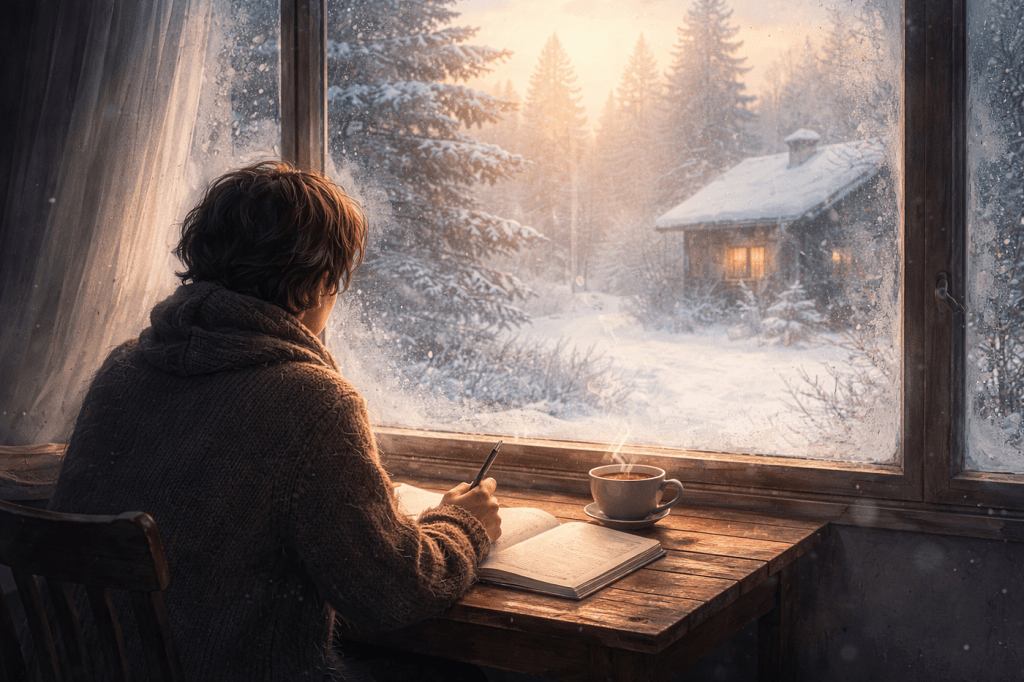
This kind of writing feels like sitting beside a window, notebook open, watching flakes fall and letting thoughts drift in and out without pressure. It’s not about finishing something. It’s about listening.

Snow gives permission to write unfinished things.

Fragments. Half-formed images. Feelings without conclusions.

Rest That Isn’t the End

There’s a cultural pressure to treat rest as something earned—or worse, something temporary until we can get “back on track.” Snow doesn’t follow that logic. It arrives when it arrives. It stays as long as it needs. And when it melts, the world is often quieter, cleaner, ready.

Rest in winter isn’t failure. It’s preparation.

Snow reminds us that awakening doesn’t always look loud or dramatic. Sometimes it looks like stillness. Sometimes it looks like patience. Sometimes it looks like trusting that movement will come back in its own time.

Standing at the Threshold

If you’re in a season that feels quiet, heavy, or uncertain, snow offers a gentle truth: you are not behind. You are between.

Between what you were and what you’re becoming.
Between exhaustion and renewal.
Between holding on and opening up.

And that space—fragile, hushed, liminal—is not something to rush through.

It’s something to stand inside, breathe in, and let shape you.

Happy Writing ^_^

2026, February 2026

Three Things Winter Helped Me See More Clearly

Winter has a way of slowing everything down—whether we want it to or not. The shorter days, the colder air, the quiet that settles in after snowfall… it all creates space to notice things we might rush past the rest of the year.

This winter, especially, asked me to pause. To look honestly at where I am, what I’m working toward, and what simply needs more time. Here are three things winter helped me see more clearly.

1. Some goals are meant for now, others are meant for later

Winter showed me that not every goal needs to be chased at full speed. Right now, my focus is on steadiness—supporting my health, protecting my energy, and building my life in ways that don’t demand more than I can give.

There are goals I’m holding gently in the present: continuing my writing, growing my business slowly, staying connected to what brings me meaning. And there are goals that belong to the future—bigger plans, long-term dreams, things that will unfold when my body and life are ready.

Winter reminded me that postponing something doesn’t mean abandoning it. It just means honoring timing.

2. Healing and change take longer than we want—and that’s okay

Winter doesn’t rush. Snow doesn’t ask permission before it falls, and it doesn’t melt the moment we want it gone. It takes its time, responding to warmth when it comes.

Living with ongoing health challenges has taught me the same lesson. Some things won’t resolve quickly, no matter how much effort or hope I pour into them. Winter helped me release the pressure to “fix” everything at once and instead focus on care, patience, and small, consistent steps.

Progress doesn’t always look dramatic. Sometimes it looks like rest. Sometimes it looks like survival. Sometimes it looks like choosing kindness toward myself on hard days.

3. What remains after the snow melts is what matters most

Watching the snow fall—and later disappear—reminded me that even when something beautiful fades, what’s underneath is still there. Life keeps going. The important things don’t vanish just because a season ends.

After the snow melts, what’s left are the things worth tending to every day: moments of peace, creativity, connection, presence. Winter encouraged me to enjoy what’s in front of me instead of constantly waiting for the next milestone or “better” season.

Each day holds something worth noticing, even if it’s small. Even if it’s quiet.

Happy Writing ^_^

2026, February 2026

How Snow Changes the Way I Write

Snow always makes me slow down.

When it falls, everything feels quieter—like the world has decided to pause for a moment and breathe. I find myself staring out the window more than usual, watching the way it softens the edges of everything it touches. Trees look gentler. Roads look calmer. Even time seems to move differently.

Snow reminds me to enjoy what’s in front of me instead of rushing past it. There’s a kind of permission in it—to stop, to notice, to sit with the moment exactly as it is. I don’t feel the same urgency to produce or push myself forward. Instead, I feel invited to observe.

It’s also a reminder of how rare snow is in some places. Because it doesn’t happen often, it feels special when it does arrive. That rarity makes me pay closer attention. I want to remember how it looks, how it feels, how it changes the air and my mood. It becomes something worth holding onto, even after it melts away.

When I write during snowy days, my words soften. My stories become quieter, more introspective. I focus more on atmosphere, emotion, and stillness. Snow pulls me inward, away from noise and expectations, and closer to what I’m really feeling.

Writing Inspiration Snow Brings Me

Snow doesn’t always give me plot-heavy ideas—it gives me moments. Small scenes. Emotional pauses. The kinds of details that make stories feel lived in.

Some writing ideas that snow often inspires for me:

  • A character who finds clarity during a snowfall after a long period of chaos
  • A quiet conversation that only happens because the world outside has gone still
  • A journey delayed by snow, forcing characters to rest, reflect, or connect
  • A memory tied to winter that resurfaces when the first snow falls
  • A setting where snow acts like a veil—hiding truths, secrets, or emotions

Snow also reminds me that writing doesn’t always have to be fast or loud to be meaningful. Some of the most powerful scenes are quiet ones. A character watching the snow fall. A breath fogging in cold air. A moment of stillness before something changes.

On snowy days, I give myself permission to write slowly—or simply to think about writing. To journal instead of draft. To describe instead of explain. To let atmosphere lead instead of forcing structure.

In a world that constantly pushes for speed, snow teaches me that there is value in slowing down. In looking. In being present. And sometimes, that stillness is where the best writing begins.

Happy Writing ^_^

2025 Months, October 2025

🍂 Why Autumn Makes Me Rethink My Creative Process

Every year, when the air turns crisp and the world trades its greens for a thousand shades of gold and rust, I find myself slowing down — not just in body, but in creativity. Autumn has a way of whispering, “Breathe. Reflect. Begin again.”

It’s not just a season of endings. It’s a season of refinement — of shedding what no longer works and preparing the ground for something more authentic to grow. For me, that shift always brings a deep reassessment of how I create.


🌙 Letting Go of Rigid Expectations

During summer, I tend to chase momentum — new projects, big goals, and ambitious word counts. But autumn reminds me that growth doesn’t always mean constant expansion. Like the trees letting go of their leaves, there’s power in release.

I look back at what I’ve been forcing — ideas that don’t fit, habits that drain instead of inspire — and ask myself: What can I let fall away?

This simple question often clears more space than any productivity system ever could.


🕯️ Embracing a Slower Creative Rhythm

Autumn’s shorter days and longer nights bring a rhythm that feels more inward. My creative energy shifts from fiery action to quiet reflection. I write more slowly, journal more deeply, and rediscover the joy of creating for the sake of curiosity rather than deadlines.

I light candles, make tea, and let stories unravel in their own time. This slower pace doesn’t mean I’m doing less — it means I’m listening more closely to the story, to myself, and to the spaces between thoughts.


🍁 Reconnecting with Ritual

There’s something sacred about seasonal routines — the way light filters differently through the window or how morning walks feel alive with change. I find that when I align my creative rituals with the season, my process feels more sustainable.

In autumn, my rituals are smaller, simpler:

  • A journal session while watching the leaves fall.
  • Editing by candlelight.
  • A warm playlist that carries the mood of fading daylight.

These little habits remind me that creativity isn’t just an act — it’s a relationship with time, rhythm, and renewal.


🔮 Preparing for the Next Cycle

While it might seem like a season of slowing down, autumn is also when I start to dream about what’s next. I brainstorm winter writing challenges, sketch outlines for stories I’ll nurture through the colder months, and take stock of my creative landscape.

It’s not about rushing toward the next thing — it’s about noticing what’s ready to evolve.
Autumn, in its quiet wisdom, reminds me that endings and beginnings are often the same thing seen from different sides.


🌤️ Closing Thoughts

Autumn doesn’t demand productivity; it invites presence. It asks us to honor the creative process as something cyclical — to let go, reflect, rest, and return renewed.

So as I wrap myself in a blanket and watch the golden world drift by, I remind myself:
Creativity isn’t a race. It’s a season — and autumn is one of the most beautiful times to begin again.

2025 Months, September 2025

September Prompts That Lead Into October Stories – From Cozy to Eerie

September is the month of golden afternoons, crisp air, and the comfort of sweaters. But as the month wanes, shadows grow longer, nights stretch deeper, and the air carries a hint of mystery. It’s the perfect season to let your writing follow nature’s lead—moving from the warmth of September coziness into the eerie atmosphere of October.

Below, you’ll find a series of prompts designed to flow with that seasonal shift. Start with comfort and end with chills.


🍎 Cozy September Prompts

Ease into September’s comfort with soft, nostalgic scenes:

  1. A character bakes their first apple pie of the season—what secret ingredient makes it unforgettable?
  2. Write a scene where two friends meet under a tree just as the leaves start to change.
  3. A library tucked away in town has a seasonal reading nook that everyone loves—what happens there one rainy afternoon?
  4. A character knits a scarf for someone they secretly admire.
  5. Describe the feeling of opening the window to the first truly crisp September morning.

🍂 Transitional Prompts – September to October

Here, coziness lingers, but the edges blur into something mysterious:

  1. A foggy evening covers the neighborhood, but one house glows brighter than the rest.
  2. While raking leaves, a character uncovers an old box buried beneath the oak tree.
  3. The local café’s autumn drink special has an odd name—when a character orders it, strange things begin to happen.
  4. Two friends walk through a pumpkin patch at dusk and realize they’re not alone.
  5. A character notices their shadow doesn’t move quite in sync anymore.

🌙 Eerie October Prompts

Step fully into the darker mood of October with chilling sparks:

  1. A jack-o’-lantern left on the porch refuses to go out, no matter how many times it’s blown out.
  2. A character hears whispers in the cornfield, calling their name.
  3. The autumn carnival arrives in town overnight—but no one remembers seeing it set up.
  4. An attic chest locked for generations begins to rattle every evening at the same time.
  5. A character follows falling leaves down a deserted street, only to realize the leaves are leading them somewhere intentional.

How to Use These Prompts

  • Start cozy and progress through the list as September ends. You’ll naturally build toward eerie stories perfect for October.
  • Try writing one scene a day, then weave them into a short story collection that mirrors the seasonal shift.
  • Or, use the prompts to explore the same characters in different moods—watching how they react when their world tilts from warmth to unease.

Final Thoughts

September is all about balance: the warmth of lingering summer against the cool touch of fall. By writing with that progression, you give your stories a natural rhythm that shifts from comfort to chill—just in time for October’s eerie embrace.

🍂 So light a candle, brew some tea, and let your stories follow the season’s turn.

Happy Writing ^_^

2025 Months, September 2025

Harvesting Ideas: How to Gather Inspiration Like Autumn Crops

As the seasons shift into autumn, the world around us becomes a living metaphor for creativity. Just as farmers reap what has been nurtured through spring and summer, writers and creators can also gather ideas that have been slowly ripening in their minds. Autumn invites us to pause, reflect, and gather inspiration from both what has grown and what is ready to be transformed.

Notice the Seeds You’ve Already Planted

Every idea starts small, like a seed buried in the soil. Maybe it’s a scribbled note in your journal, a scene you once imagined, or a character who whispers in your thoughts at odd hours. Autumn is the time to revisit those forgotten seeds and ask: which ones are ready to grow into stories? Which ones need more time underground?

Gather What the Season Offers

Farmers don’t harvest crops that aren’t in season. Likewise, not every idea will be ready right now. Look for inspiration that feels ripe:

  • The crisp air that stirs nostalgia.
  • The sound of leaves crunching beneath your feet.
  • The bittersweet feeling of shorter days and longer nights.
    These seasonal details can ground your writing in texture and mood.

Sort the Harvest

Not every pumpkin makes it to the market, and not every idea belongs in your current draft. Sort through your “harvest” of ideas with intention. Some belong in the compost pile (they served their purpose but won’t grow further). Others can be preserved—stored in a notebook or file to revisit later. The best ones, fresh and vibrant, become your creative feast for now.

Preserve for the Winter

Crops are often dried, canned, or frozen for the months when the earth rests. Do the same with your ideas. Jot them down in a seasonal journal, record voice notes, or create mood boards. Even if you don’t use them today, they’ll be there waiting when inspiration feels scarce.

Share the Bounty

Autumn harvests are communal celebrations. Creativity can be the same. Share snippets of your work, brainstorm with friends, or offer prompts and reflections to others.

Happy Writing ^_^

2025 Months, August 2025

🌀 Create a Fictional Island That Only Appears in Late Summer

What if your character stumbled upon an island that wasn’t on any map?

Not because it was forgotten, or erased, or shrouded in myth—but because it only exists during one brief, magical sliver of the year.

Welcome to the idea of the Late Summer Island—a setting that emerges with the cicadas, the golden light, and the heavy stillness before fall’s first winds. This mysterious location could be the heart of your next short story, novel, or seasonal writing challenge.

🌙 The Island’s Rules: Why Late Summer?

This island doesn’t drift like a mirage—it blinks into existence in late summer and vanishes as the season turns. Maybe it’s tied to a solstice calendar, the blooming of a rare flower, or the breaking of a curse that only weakens in the heat of late August. Its brief appearance creates urgency. A ticking clock. A last chance.

Ask yourself:

  • Why this time of year?
  • Is the island affected by the heat, humidity, or lunar cycle?
  • Does it vanish at a specific time—sunset on the last summer day, or the first drop of autumn rain?

🌿 What Makes It Magical (or Dangerous)?

This island could be:

  • A safe haven forgotten by the world
  • A cursed place sealed off from the rest of reality
  • A liminal realm where time moves differently or memories shift
  • A testing ground for travelers, dreamers, or exiles

Your island might have sentient trees, ghostly echoes of past visitors, or ruins that rebuild themselves. Or perhaps it offers impossible temptations—fountains of youth, glimpses of the dead, or a chance to rewrite regret.

Let atmosphere do the heavy lifting:

  • Fog that never lifts
  • Flowers that bloom only once and scream as they wilt
  • Tides that bring back things long thought lost

🧭 Who Finds It—and Why?

Since the island isn’t always there, your characters have to earn it.

Maybe:

  • A lost sailor sees it in a dream and follows the call.
  • A grieving parent stumbles into its magic while searching for closure.
  • A historian chasing a myth finally aligns the dates and dares to step through the summer veil.

Their motivations shape how the island reacts. Is it a place of healing? Of reckoning? Of rebirth?

✍️ Writing Prompt Ideas

  1. The Summer Map: A child’s drawing leads a traveler to a sandbar that becomes a lush, ancient island only for seven nights each year.
  2. The Island Remembers: Each visitor leaves something behind—a memory, a scar, a song—and the island whispers those remnants back to the next person who arrives.
  3. Last Sunset: A group of strangers wakes up on a beach. The island appeared overnight—and the sun is already sinking. They must uncover the island’s secret before it disappears again.
  4. The Returner’s Pact: Your character has been to the island before. But this year, it’s different. The island wants something in return.

💭 Challenge:

Write a scene set on your own Late Summer Island. Describe the sounds, smells, and emotions it evokes. What truths emerge in the heat? What will your characters lose—or gain—by stepping onto the sand?

Happy Writing ^_^

2025 Months, August 2025

What If August Was a Sentient Spirit?

Have you ever wondered if the months of the year were more than just a measure of time? What if each month had a personality, a spirit, a presence that shaped the world around us?

Let’s take a step into the unknown and imagine that August, with its lingering heat and last glimpses of summer, was not just a month on the calendar—but a sentient spirit.

The Nature of August

August is often seen as a month of transition. It’s the final stretch before the coolness of autumn sets in, and it’s filled with a kind of lingering intensity. It’s a month where summer’s warmth is still very much alive, but it begins to soften, anticipating the changes to come.

Imagine August as a being that embodies this in-between state. A spirit that feels the heat of the sun on its skin, the pulse of long days, and the charge in the air that comes just before a storm. August would be a spirit of change, constantly watching the world around it shift and evolve, knowing that its time is running out. This would be a spirit that does not shy away from the inevitable, but instead embraces it, savoring every last moment of summer before it fades into the fall.

The Role of August as a Spirit

If August were a sentient spirit, it would be the one who lingers at the edge of the season, coaxing summer to hold on just a little longer. It would be the spirit that fuels those last few adventures, the hot afternoons spent by the pool, the late nights around a bonfire, and the warm, golden sunsets that seem to stretch endlessly across the horizon.

But, like all spirits, August wouldn’t be content to simply watch. It would act as a guide—reminding us to savor the present while preparing for what’s ahead. It would be the spirit that whispers to us in moments of stillness: “Don’t rush. There’s time yet. But don’t forget that change is coming.”

In this way, August would be both a muse and a mentor. It would encourage us to take those last moments of summer for ourselves—to indulge in a lazy afternoon, to make memories that linger in the warmth of the sun. But it would also prompt us to look ahead, to set intentions, and to begin the slow shift toward the cooler, quieter days of fall.

The Influence of August’s Energy

The energy of August would be one that calls us to take a deep breath and embrace both the excitement and the melancholy of transition. August wouldn’t force us to change or rush. Instead, it would invite us to reflect on the past months, to celebrate what we’ve experienced, and to let go of what no longer serves us.

But it would also remind us that change is inevitable—and even beautiful. There’s a reason why August is the precursor to autumn. Just as summer fades into fall, we too must ebb and flow with the seasons of our lives.

In August’s presence, we might feel a certain restlessness—the urge to squeeze every last drop out of the summer. Yet, we would also feel a quiet satisfaction in knowing that this is the time to prepare for the shift ahead, much like the spirit of August prepares the earth for autumn’s arrival.

The Gifts August Brings

If August were a sentient spirit, it would bring with it gifts—small yet profound offerings for those who are open to them. First, it would bring clarity. August has a way of making us reflect on where we’ve been and where we’re going. It’s a time when the buzz of summer starts to quiet, and we are left with an opportunity to check in with ourselves, our dreams, and our goals.

It would also bring patience. Though August knows that its time is running out, it encourages us not to rush. The days may grow shorter, but that doesn’t mean we should hurry to finish what we’ve started. Instead, it would ask us to savor each moment, whether it’s a moment of stillness or a burst of activity.

Lastly, August would gift us resilience. It would remind us that even as things change—whether it’s the seasons or our own lives—we have the strength to endure and adapt. Just as the earth endures the heat of August before shifting into the calm of fall, we too are capable of weathering the transitions that life throws our way.

A Thought to Leave You With

So, next time August rolls around, take a moment to imagine the spirit of the month—waiting just outside the door, gently urging you to savor the heat of the sun while also preparing for the quiet beauty of fall. August, as a sentient spirit, would encourage us to live fully in the present while accepting that change is just around the corner.

In embracing August, we embrace both the summer’s warmth and the fall’s promise, finding balance in transition and beauty in the inevitable. 🌿

What do you think? What do you imagine August might look like if it were a sentient spirit? Share your thoughts in the comments below!

Happy Writing ^_^

GoFundMe Link

2025 Months, August 2025, Moon writing

Full Moon Phase Writing Challenge: January–August

Use each full moon’s name and meaning as the spark for your writing. These prompts can be woven into your own stories, used to build lore for your fictional worlds, or inspire standalone scenes and poems.

January 13 – Wolf Moon

When the Wolf Moon rises, the howling isn’t from wolves—it’s from something older, hunting under the snow. The sound drives anyone who hears it to run toward the forest… never to return.

Prompt: Who dares to follow the sound, and why?

February 12 – Snow Moon

The Snow Moon doesn’t just light the sky—it calls down an endless, blinding snowfall. But each snowflake carries whispers from the dead, and some of them are calling your name.

Prompt: What message is buried in the snowfall?

March 14 – Worm Moon

Under the Worm Moon, the soil itself stirs. Roots twist, earthworms grow to monstrous size, and something ancient wakes beneath the thawing ground.

Prompt: What emerges, and what does it want?

April 12 – Pink Moon

On the night of the Pink Moon, the wildflowers open in the dark, glowing faintly and bleeding a sweet, intoxicating scent. Anyone who inhales it dreams of a place they’ve never been—but the next morning, they wake there.

Prompt: Where have they been taken, and by whom?

May 12 – Flower Moon

During the Flower Moon, blossoms grow overnight, climbing walls and swallowing buildings. But each flower hides an eye that watches and learns.

Prompt: Who—or what—is behind the bloom?

June 11 – Strawberry Moon

The Strawberry Moon turns rivers red—not with blood, but with a sweet, shimmering liquid that grants visions of the future. Drinking it, however, binds you to fulfill that vision, no matter the cost.

Prompt: What future do you see, and will you accept it?

July 10 – Buck Moon

Under the Buck Moon, antlers sprout not just on deer, but on people chosen by an unseen force. These “antlered ones” are said to be protectors of the forest, but they are also its prisoners.

Prompt: What happens when you grow antlers?

August 9 – Sturgeon Moon

The Sturgeon Moon draws the great fish to the surface, their scales glowing with ancient runes. Catching one could grant immortality… but it also awakens the lake’s guardian.

Prompt: Do you take the risk to catch one?

Remaining Full Moon Phases (September–December)

  • September 7 – Corn Moon / Harvest Moon
  • October 6 – Hunter’s Moon
  • November 5 – Beaver Moon
  • December 4 – Cold Moon

Bonus Challenge Idea for the Remaining Moons

To continue the challenge into September–December, choose one of these approaches:

  1. Story Arc Moon Challenge – Let each remaining moon trigger the next stage of a larger story. Example: In September, your character gains a magical harvest gift; in October, they must use it to survive the hunt; in November, they must bargain with the beavers (or other dam builders) to build defenses; in December, the Cold Moon forces the final confrontation in the frozen dark.
  2. Character Growth Moon Challenge – Assign each moon to a personal trial for your protagonist or antagonist. These trials could test loyalty, courage, love, or morality. By the end, the moons have transformed the character permanently.
  3. World-Building Moon Challenge – Treat each moon as a seasonal festival or ritual in your fictional world. Write a scene showing how your culture celebrates—or fears—each one. This could expand your story’s lore while deepening the setting.

Happy Writing ^_^