2025 Months, December 2025

🎄 A Quiet Christmas Gift for Writers

This season, I wanted to offer something different.

Not another checklist.
Not a “write faster” challenge.
Not a shiny, surface-level holiday prompt pack.

Instead, I created a gift for writers who want to slow down, go inward, and write with intention—across any genre, including fiction, nonfiction, memoir, and poetry.

✨ Introducing: 100 Christmas Writing Challenges

These prompts aren’t about forcing joy or recreating postcard holidays.

They’re about:

  • memory and time
  • grief and healing
  • belonging and identity
  • love, distance, and silence
  • transformation, endings, and becoming

They’re for writers who:

  • feel complicated about the holidays
  • write through chronic illness, grief, or burnout
  • prefer depth over productivity
  • want prompts that hold space instead of rushing answers

This collection was designed to meet you where you are, not where tradition says you “should” be.


🌲 What Makes These Writing Challenges Different

Each challenge is intentionally expanded and reflective, inviting you to:

  • Write scenes, not snippets
  • Explore inner change, not just plot
  • Use the same prompt for fiction, essay, memoir, or poetry
  • Sit with complexity instead of resolving it too quickly

These aren’t “finish in 10 minutes” prompts.

They’re invitations to:

  • linger
  • question
  • listen
  • return to the page gently

You can spend one session or several days with a single challenge.


🖋️ Designed for All Writers & All Genres

Whether you write:

  • fantasy, romance, horror, or literary fiction
  • personal essays or reflective nonfiction
  • poetry, prose poetry, or hybrid work
  • journal entries you never plan to share

These challenges are intentionally open-ended, so your voice—not the prompt—leads the way.

Each one can be approached as:

  • a scene
  • a lyric meditation
  • a braided essay
  • a journal reflection
  • or a single powerful paragraph

There is no “right” outcome—only honest engagement.


❄️ You Don’t Have to Write Happy to Write Meaningfully

One of the quiet truths of December is this:

Not every season of life feels festive—and that doesn’t make your writing less valid.

This gift was created especially for writers who:

  • feel pressure to be joyful
  • struggle with the holidays
  • are carrying grief, fatigue, or change
  • want permission to write what’s real

You are allowed to write Christmas as:

  • reflective
  • unresolved
  • soft
  • dark
  • quiet
  • hopeful in small ways

All of it belongs.


🎁 How to Use This Gift

You might:

  • choose one challenge a day
  • circle the ones that call to you and ignore the rest
  • write only a paragraph at a time
  • return to the same prompt year after year
  • use them as journaling anchors when words feel far away

There’s no deadline.
No completion requirement.
No pressure.

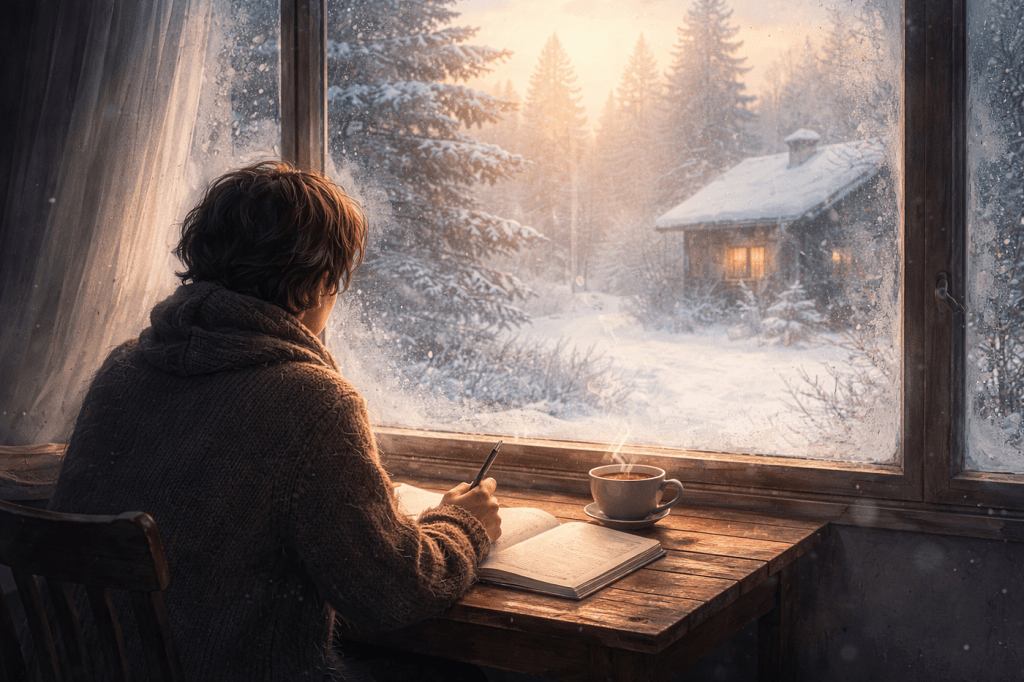
Just a page, a pen, and your voice.


🤍 A Gentle Invitation

If you’ve been feeling disconnected from your writing…
If December feels heavy or complicated…
If you want to create without forcing cheer…

This gift is for you.

May these prompts meet you with kindness, depth, and room to breathe.

You don’t need to write the Christmas story you think you should write.

You only need to write the one that’s true.

Sara
Sara’s Writing Sanctuary

2025 Months, December 2025

On Christmas Eve, Let Your Stories Rest

Christmas Eve carries a different kind of quiet.

Even in homes filled with light, music, or family, there’s a pause in the air—a sense that something is waiting. The rushing slows. The expectations soften. The world inhales before tomorrow.

Your stories feel that shift too.

If you’re a writer who has been pushing through deadlines, guilt, burnout, illness, or simply the weight of showing up every day, Christmas Eve is not a day to force words onto the page. It’s a day to let your stories rest.

Rest Is Not Abandonment

Letting your stories rest does not mean you’ve failed them.

It doesn’t mean you’ve given up.
It doesn’t mean you’ve lost your identity as a writer.
It doesn’t mean the magic is gone.

Stories, like people, need pauses. They need quiet spaces where they’re allowed to exist without being used or improved or finished.

Tonight, your characters don’t need to perform.
Your plot doesn’t need fixing.
Your unfinished draft doesn’t need an apology.

It just needs permission to breathe.

Stories Grow in Stillness

Some of the most important creative work happens when you are not writing.

When you’re resting, your mind continues to weave threads.
When you’re sleeping, your imagination wanders.
When you’re present in the moment—lighting candles, watching snow fall, sitting in silence—your stories are still listening.

Christmas Eve is a threshold. A liminal space between what has been and what’s coming next. That’s fertile ground for creativity, even if no words appear on the page tonight.

You Are Allowed to Be Human First

Many writers struggle during the holidays—especially those carrying chronic illness, grief, mental health challenges, or exhaustion from trying to do too much for too long.

If writing has felt heavy lately, that doesn’t make you weak.
If you haven’t met your goals this year, that doesn’t erase your worth.
If all you can do tonight is rest, that is still enough.

You are not a machine designed to produce stories.
You are a living being who creates because you feel, imagine, and survive.

And tonight, survival and softness matter more than productivity.

A Gentle Invitation for Tonight

Instead of writing, consider this:

  • Sit with your story in your thoughts, without judgment.
  • Light a candle and imagine it warming your characters.
  • Whisper gratitude for the ideas that stayed with you this year.
  • Promise your story you’ll return when you’re ready—not when you’re pressured.

No notebook required.
No word count expected.
No hustle allowed.

Tomorrow Will Come

Your stories are not going anywhere.

They’ll still be there after the holiday lights dim.
They’ll still want you when the calendar turns.
They’ll still recognize you—even if you’ve been quiet for a while.

Tonight, let Christmas Eve be what it’s meant to be:
A pause.
A breath.
A moment of grace.

Let your stories rest.

They trust you to come back when the time is right. 🌙✨

Happy Writing ^_^
Merry Christmas Eve

2025 Months, December 2025

What This Year Taught Me About Writing (Without Hustle)

This year didn’t teach me how to write faster.
It didn’t teach me how to publish more.
It didn’t teach me how to push through at all costs.

What it taught me was quieter—and far more important.

It taught me how to keep writing without burning myself out.

This year has been a lot.

Between moving, finishing college, and the slow creep of burnout, writing hasn’t felt easy—or joyful—the way it once did. I’ve struggled not just to write, but to want to write, and that loss of enjoyment has been one of the hardest parts.

My health hasn’t helped. Over the last few months, ongoing GI issues and chronic pain have taken a real toll on my body and energy. When you’re already exhausted, pain doesn’t just affect your physical limits—it seeps into your creativity, your focus, and your sense of self.

Depression followed quietly but persistently. It made even small tasks feel heavy. Showing up for my website. Working on my own stories. Doing the things I care deeply about—all of it took more effort than I expected, and more time than I hoped.

On top of that, I work a full-time job. Juggling work, health, school transitions, and creative goals has been overwhelming at times. The constant pressure of doing everything every day adds up, and I’ve felt that weight deeply this year.

For a long time, I believed that writing had to look a certain way to “count.”
Daily word counts. Streaks. Deadlines that didn’t bend. If I wasn’t pushing, I felt like I was failing.

This year gently dismantled that belief.

Consistency Isn’t the Same as Pressure

I learned that showing up doesn’t mean forcing myself to perform on days when my body or mind is struggling.

Some days, showing up looked like:

  • Writing a single paragraph
  • Jotting down a character note
  • Revising one sentence
  • Or simply opening the document and sitting with it
  • Or just reading

Consistency, for me, became about returning—not producing.

And that shift changed everything.

Writing Is Cyclical, Not Linear

There were weeks when ideas poured out effortlessly.
There were months when silence felt heavy.

Instead of panicking during the quiet periods, I started listening.

Creativity has seasons:

  • Growth
  • Rest
  • Integration
  • Renewal

This year taught me that rest isn’t a failure—it’s part of the process. Stories don’t disappear when we pause. They deepen.

Hustle Culture Lies About Worth

One of the hardest lessons was unlearning the idea that my value as a writer depended on productivity.

I didn’t write less because I was lazy.
I wrote differently because I was human.

Writing through illness, chronic pain, emotional weight, and real life required softness—not discipline sharpened into a weapon.

Letting go of hustle allowed me to:

  • Write with more honesty
  • Choose projects intentionally
  • Protect my creative energy

Small Work Still Matters

Some of the most meaningful writing I did this year never turned into polished pieces.

It lived in:

  • Journal pages
  • Half-finished drafts
  • Voice notes
  • Fragmented scenes

And yet, that work mattered.

Those fragments are seeds.
Those pages are proof.
Those quiet moments are where stories begin.

Writing as a Relationship, Not a Demand

The biggest lesson of all?

I didn’t give up.

I slowed down.
I took longer than planned.
I rested when I needed to—even when it felt uncomfortable or disappointing.

Progress didn’t always look like momentum. Sometimes it looked like survival. Sometimes it looked like patience. Sometimes it looked like choosing not to quit when everything felt heavier than it should.

Writing doesn’t have to be something I chase.
It can be something I return to.

When I stopped demanding results from myself, writing became safer again.
More honest.
More mine.

Moving Forward, Gently

I’m not leaving this year with a promise to “do more.”

I’m leaving it with permission to:

  • Write slower
  • Rest without guilt
  • Trust my process
  • Create in ways that honor my life instead of fighting it

I’m still here.
My stories are still here.
And my love for writing—even when it’s quiet—hasn’t disappeared.

It’s just resting. And that’s okay.

Happy Writing ^_^

2025 Months, December 2025

How to Restart a Writing Project You Abandoned Months Ago

There’s a particular kind of guilt that comes with opening an old document you haven’t touched in months.

The half-finished chapter.
The abandoned outline.
The story that once mattered deeply—and now feels distant, heavy, or intimidating.

If you’ve been avoiding a project you walked away from, you’re not lazy, broken, or “bad at finishing things.” You’re human. Life changes. Energy shifts. Bodies get tired. Priorities rearrange themselves.

The good news? You don’t need to start over—or punish yourself—to begin again.

Here’s how to gently and realistically restart a writing project you abandoned months (or years) ago.


1. Release the Myth of “Picking Up Where You Left Off”

One of the biggest reasons writers stay stuck is the belief that they must restart exactly where they stopped.

You don’t.

You’re allowed to:

  • Reread and change your mind
  • Rewrite scenes that no longer fit
  • Skip ahead
  • Restructure the entire project

You are not the same writer you were months ago—and that’s not a failure. It’s growth.

Permission slip: You’re allowed to return as a new version of yourself.


2. Re-enter the Story as a Reader, Not a Writer

Before you try to write anything new, shift your role.

Instead of asking, “What should I fix?”
Ask, “What still works?”

Try this:

  • Read without editing for 15–20 minutes
  • Highlight moments you still like
  • Make notes only about interest, not problems

You’re not here to judge past-you. You’re here to reconnect emotionally with the story.

If nothing sparks? That’s information—not a verdict.


3. Write a “Re-Entry Page” (Not a Chapter)

Jumping straight back into drafting can feel overwhelming. Instead, write around the project first.

Use a blank page and respond to one or two of these prompts:

  • What excited me about this story originally?
  • What feels heavy or stuck now?
  • If I were starting today, what would I want this story to be about?
  • What question is this story asking?

This page is not part of the book.
It’s a bridge back into it.


4. Shrink the Goal Until It Feels Almost Too Easy

If you abandoned the project because of burnout, pressure, or exhaustion, restarting with big expectations will trigger the same shutdown.

Instead of:

  • “Finish the next chapter”
  • “Fix the plot”
  • “Get back on track”

Try:

  • Write 150 words
  • Rewrite one paragraph
  • Add sensory details to one scene
  • Freewrite for 10 minutes about a character

Momentum comes from success, not discipline.


5. Give Yourself Permission to Change the Plan

Sometimes projects stall because the original structure no longer fits the story—or you.

You’re allowed to:

  • Change POV
  • Cut a character
  • Alter the ending
  • Shift genre emphasis
  • Turn a novel into a novella (or vice versa)

Abandonment doesn’t always mean failure.
Sometimes it means the story needed time to become something else.


6. Decide—Gently—If This Project Still Belongs to You

Not every abandoned project needs to be revived.

Ask yourself honestly:

  • Does this story still spark curiosity?
  • Am I returning out of love—or guilt?
  • Would I choose this project today?

Letting a project rest permanently is not quitting. It’s discernment.

But if even a small part of you feels a pull—that’s enough to begin again.


7. Rebuild Trust With Yourself (Not Just the Story)

Restarting isn’t just about the project—it’s about repairing your relationship with your creativity.

Keep promises small.
Show up imperfectly.
Stop measuring progress by speed or word count.

Every gentle return teaches your nervous system:
It’s safe to come back.


Final Thought: The Story Has Been Waiting—Not Judging

That abandoned project isn’t angry with you.
It hasn’t been keeping score.

It’s been waiting quietly for the moment you were ready to approach it with more care, more self-understanding, and less pressure than before.

You don’t need to restart perfectly.
You just need to start honestly.

And that is more than enough.

Happy Writing ^_^

2025 Months, December 2025

Using Timers, Prompts & Constraints to Spark Creativity

Tracking Writing Progress Without Stress

Creativity doesn’t always respond to pressure.
For many writers—especially those navigating burnout, chronic illness, ADHD, or simple creative fatigue—traditional productivity advice can feel more suffocating than motivating.

But structure doesn’t have to be rigid.
When used gently, timers, prompts, and creative constraints can actually free your imagination—and help you track progress without guilt or overwhelm.

This post explores how to use these tools as creative invitations, not demands.


Why Structure Can Help (When It’s Gentle)

The blank page is intimidating because it offers infinite choices.
Timers, prompts, and constraints narrow the field just enough to quiet the inner critic and invite play.

Think of them as containers, not cages.

Instead of asking:

“How much should I write?”

You’re asking:

“What can I explore for a few minutes?”

That shift changes everything.


Using Timers: Writing Without Overthinking

Timers are one of the most powerful tools for writers who struggle with starting—or stopping.

Why timers work

  • They reduce decision fatigue
  • They lower the stakes (“It’s only 10 minutes”)
  • They give your brain permission to experiment

Gentle timer ideas

  • 5 minutes – Micro-writing, journaling, sensory notes
  • 10–15 minutes – Scene sketching, dialogue bursts
  • 25 minutes – Focused drafting (Pomodoro-style, but optional)

Key rule:
When the timer ends, you stop.
Stopping on purpose builds trust with yourself—and makes it easier to return later.

You’re training consistency, not endurance.


Using Prompts: Direction Without Pressure

Prompts aren’t meant to box you in. They’re meant to give your creativity somewhere to land.

A good prompt doesn’t demand a finished piece—it invites curiosity.

Ways to use prompts gently

  • Rewrite the prompt in your own words
  • Answer it as notes instead of prose
  • Use it to explore backstory, mood, or theme
  • Abandon it halfway through if something else sparks

Prompts are starting points, not contracts.

If a prompt leads you somewhere unexpected, follow that thread. That’s not failure—that’s creativity doing its job.


Using Constraints: Freedom Through Limitation

Constraints sound restrictive, but they often unlock surprising ideas.

When everything is possible, it’s easy to freeze.
When something is limited, the imagination gets inventive.

Gentle constraint ideas

  • Write only dialogue
  • Write one paragraph
  • Use one emotion for the entire piece
  • Write from a secondary character’s perspective
  • Limit yourself to 100 words (or even 50)

Constraints give you a clear edge to push against—and that resistance creates momentum.


Tracking Writing Progress Without Stress

Not all progress is measurable in word counts.

If tracking your writing makes you anxious, it’s time to redefine what counts.

Low-pressure ways to track progress

  • Minutes spent writing (not words)
  • Days you showed up, even briefly
  • Prompts explored
  • Scenes sketched
  • Notes taken
  • Ideas captured

You can track progress with:

  • A simple checklist
  • A calendar mark
  • A notebook tally
  • A “done list” instead of a to-do list

Progress isn’t just output.
It’s attention, presence, and return.


A Gentle Writing Formula to Try

Here’s a low-stress way to combine everything:

  1. Choose one prompt
  2. Set a 10-minute timer
  3. Add one constraint (dialogue only, one emotion, etc.)
  4. Write until the timer ends
  5. Stop—even if you want to continue

If you do want to keep going, reset the timer intentionally.

This keeps writing from becoming a drain—and helps it stay something you look forward to.


Final Thoughts: Creativity Thrives on Kind Structure

You don’t need harsher discipline.
You don’t need to push harder.

Often, creativity blooms when you offer it:

  • A small window of time
  • A gentle nudge of direction
  • Permission to stop

Timers, prompts, and constraints aren’t productivity hacks—they’re acts of creative care.

Showing up gently still counts.
And it always will.

Happy Writing ^_^

2025 Months, December 2025

Why Writing Is Still Worth It (Even When It’s Hard)

There are seasons when writing feels like breathing—and seasons when it feels like dragging words uphill through mud.

You sit down with the best intentions.
The cursor blinks.
Your body hurts, your mind wanders, your confidence wavers.
And that familiar question rises again:

Why am I still doing this?

If you’ve asked yourself that lately, this post is for you.

Because the truth is: writing is still worth it—even when it’s hard.
Not because it’s easy. Not because it’s profitable. Not because it’s consistent.

But because of what it does—quietly, stubbornly, and deeply.


Writing Is Worth It Because It Holds Your Truth

When life feels chaotic or overwhelming, writing becomes a place where you’re allowed to tell the truth without interruption.

On the page:

  • You don’t have to be palatable
  • You don’t have to be productive
  • You don’t have to explain yourself

You can name grief. Desire. Fear. Rage. Hope.

Even when no one reads it, writing witnesses you.
And being witnessed—even by the page—matters more than we’re taught to believe.


Writing Is Worth It Because It Changes You (Even When Nothing Else Does)

Sometimes writing doesn’t change your circumstances.
It doesn’t fix the pain.
It doesn’t make things easier.

But it changes you.

It sharpens your awareness.
It helps you survive moments you didn’t think you would.
It gives shape to feelings that would otherwise stay tangled and heavy inside your body.

You may not see it day to day—but over time, writing leaves fingerprints on who you become.


Writing Is Worth It Even When You Don’t Finish

We’re taught that writing only “counts” if it becomes:

  • a finished draft
  • a published piece
  • a polished product

But unfinished writing still serves a purpose.

A paragraph written on a hard day is not wasted.
A scene abandoned taught you something.
A notebook filled with fragments is still evidence that you showed up.

Writing is not invalid just because it doesn’t reach an endpoint.

Sometimes the act itself is the destination.


Writing Is Worth It Because It Refuses to Leave You

If you’re honest with yourself, you’ll notice something:

Even when you try to quit writing…
You still think in scenes.
You still collect lines.
You still imagine stories in quiet moments.

That pull doesn’t go away.

Not because you’re obligated—but because writing is part of how you process the world.

You don’t write because you have to.
You write because something in you refuses to stay silent.


Writing Is Worth It Because It Meets You Where You Are

Writing doesn’t require perfect energy.
It doesn’t demand daily discipline.
It doesn’t need you at your best.

It meets you:

  • on low-energy days
  • during illness or grief
  • in seasons of doubt and burnout

You can write one sentence.
You can write badly.
You can write slowly.

Writing adapts to you—not the other way around.


Writing Is Worth It Because You’re Allowed to Go Gently

If writing feels hard right now, it doesn’t mean you’re failing.

It might mean:

  • you’re healing
  • you’re changing
  • you’re carrying more than usual

You don’t need to push harder to prove you’re a writer.
You don’t need to earn your creativity through suffering.

You’re allowed to rest and still be a writer.
You’re allowed to write softly and slowly.
You’re allowed to stay.


Writing Is Still Worth It—Because You Are

Even when:

  • your words feel clumsy
  • your progress feels invisible
  • your confidence feels thin

Your voice matters.
Your stories matter.
Your presence on the page matters.

Not because the world demands it—
but because you deserve a place to exist fully, honestly, and creatively.

And sometimes, that place is simply the page.


A Gentle Reminder for Today

If all you can do is open a document and breathe—
that counts.

If all you can do is think about writing—
that still counts.

Writing doesn’t leave you when it’s hard.
It waits.

And when you’re ready—even just a little—it will still be there.

Happy Writing ^_^

2025 Months, December 2025

How to Fall Back in Love With Writing

There are seasons when writing feels like oxygen—and seasons when it feels heavy, distant, or even painful.

If you’ve been staring at a blank page wondering where your love for writing went, you’re not broken. You’re human. Creativity isn’t a straight line; it’s a relationship. And like any relationship, it goes through cycles of closeness, distance, grief, and rediscovery.

Falling back in love with writing doesn’t require discipline, punishment, or forcing yourself to “push through.” It asks for curiosity, gentleness, and permission to meet yourself where you are now—not where you used to be.

First: Release the Guilt

Many writers stop writing not because they stopped loving stories—but because writing became tangled with pressure.

Deadlines. Expectations. Algorithms. Productivity rules. Comparison.

If writing only exists as something you should be doing, your nervous system will resist it.

Try this reframe:

You don’t owe writing productivity.
Writing doesn’t expire because you rested.
Your creativity isn’t gone—it’s resting or protecting you.

Let go of the version of yourself who wrote “more” or “better.” You are not required to be them again.

Return to Writing Without an Audience

One of the fastest ways to reconnect with writing joy is to remove the idea of being read.

Write something that:

  • No one will ever see
  • Doesn’t need to be good
  • Has no goal beyond existing

This could be:

  • A letter to a character you miss
  • A paragraph describing a place you love
  • A scene that makes no sense but feels alive
  • A messy journal entry about why writing feels hard

When you stop performing, writing often remembers how to breathe.

Shrink the Doorway Back In

If writing feels overwhelming, it’s usually because the doorway is too big.

Instead of:

  • “I need to write a chapter”
  • “I should finish this draft”
  • “I have to be consistent”

Try:

  • 5 minutes
  • 1 paragraph
  • 3 sentences
  • A single image or line

Falling back in love happens in small, safe moments—not grand commitments.

Consistency comes after connection, not before.

Reconnect With What Made You Write in the First Place

Ask yourself gently:

  • What kinds of stories made me fall in love with reading?
  • What themes do I return to again and again?
  • What emotions do I want to explore, not impress with?

You might discover that your interests have shifted—and that’s okay.

You don’t have to write what you used to love.
You’re allowed to fall in love with something new.

Let Writing Be a Companion, Not a Task

Writing doesn’t have to be productive to be meaningful.

Try letting writing exist as:

  • A way to process the day
  • A place to put emotions you don’t have words for yet
  • A quiet ritual instead of a goal

Light a candle. Sit somewhere comfortable. Write slowly.

You’re not “getting back on track.”
You’re rebuilding trust with your creativity.

Follow the Spark—Even If It Makes No Sense

Sometimes the thing that brings writing back isn’t the project you think you should be working on.

It might be:

  • A random worldbuilding note
  • A poem instead of prose
  • Fanfiction
  • Writing prompts
  • A single character voice that won’t leave you alone

Follow what feels warm, curious, or alive—even if it feels unproductive.

Love doesn’t grow in cages.

Remember: Writing Loves You Too

Writing isn’t judging how long you’ve been gone.
It isn’t keeping score.
It isn’t disappointed in you.

It’s still there—quietly waiting for you to show up as you are today.

You don’t need to fall back in love all at once.
You just need one honest moment at a time.

And if all you can do today is want to write again?

That’s already the beginning.

Happy Writing ^_^

2025 Months, December 2025

Creative Fatigue: How to Tell When You Need Rest, Not Discipline

We live in a world that treats discipline like a cure-all.

If you’re stuck, you must not be trying hard enough.
If you’re tired, you must be inconsistent.
If you haven’t written in days—or weeks—you must need stricter rules.

But for many writers, especially those navigating chronic illness, burnout, emotional labor, or long creative seasons, the problem isn’t a lack of discipline.

It’s creative fatigue.

And the solution isn’t pushing harder.
It’s learning how to rest without guilt.


What Creative Fatigue Actually Is

Creative fatigue isn’t laziness. It isn’t failure. And it isn’t a lack of passion.

Creative fatigue happens when your creative well is depleted, not blocked.

It often shows up when you’ve been:

  • Emotionally processing heavy material
  • Writing through stress, illness, or survival mode
  • Forcing productivity without replenishment
  • Ignoring your body’s signals for “just one more push”

Unlike procrastination, creative fatigue doesn’t disappear when you sit down and try harder. In fact, pushing through it often makes the exhaustion worse.


Signs You Need Rest (Not Discipline)

Here are some gentle signals that your creativity is asking for care, not correction:

1. Writing Feels Physically Heavy

Not just mentally difficult—but draining. Your shoulders tense. Your chest tightens. Your body resists.

That’s not avoidance. That’s fatigue stored in the nervous system.

2. You Want to Write—but Can’t Sustain Focus

You still love your story. You still think about it. But your attention slips after a few minutes, leaving you foggy or overstimulated.

This often means your brain needs recovery time, not stricter schedules.

3. Everything You Write Feels “Wrong”

When fatigue sets in, self-criticism gets louder. Sentences feel flat. Ideas feel dull. You may start believing you’ve “lost it.”

You haven’t. You’re just tired.

4. You’re Only Motivated by Guilt

If the only thing pulling you toward the page is shame—I should be writing—that’s a sign discipline is being used as a weapon instead of a support.

Creativity doesn’t thrive under punishment.

5. Rest Feels Uncomfortable or “Unproductive”

If rest makes you anxious, restless, or guilty, it’s often because you’ve been trained to equate worth with output—not because rest isn’t needed.


Discipline vs. Devotion

Discipline says: Show up no matter what.
Devotion asks: What does showing up look like today?

Sometimes devotion looks like:

  • Writing 300 messy words
  • Journaling instead of drafting
  • Reading instead of producing
  • Doing nothing—and letting your nervous system settle

Rest is not the opposite of commitment.
It’s part of the creative cycle.

Winter is not a failure of spring.


What Rest Can Look Like (Without Abandoning Your Identity as a Writer)

Rest doesn’t mean giving up on your work. It means changing how you relate to it.

Here are restorative alternatives to “push through it” writing:

  • Micro-writing: one sentence, one image, one line of dialogue
  • Sensory refills: music, nature sounds, lighting a candle, touching textures
  • Creative adjacency: reading in your genre, collecting images, daydreaming
  • Low-stakes writing: notes, voice memos, character feelings instead of plot
  • Intentional pauses: choosing rest on purpose, not as a failure response

These keep the creative thread alive without draining what little energy you have.


When Discipline Is Helpful

Discipline has a place—but only when your body and mind have capacity.

It works best when:

  • You feel rested but distracted
  • Fear—not exhaustion—is the main barrier
  • You need structure, not recovery

The key question isn’t “Am I being disciplined enough?”
It’s “Am I resourced enough?”


A Gentle Reframe

You don’t need to earn rest by burning yourself out.
You don’t need to prove your devotion through suffering.
You don’t need to punish yourself back into creativity.

Sometimes the bravest creative choice is to pause—and trust that your stories will return when you do.

Because they always do.


Reflection Prompt (Optional for Readers)

Ask yourself:

If I treated my creativity like a living thing instead of a machine, what would it be asking for right now?

Happy Writing ^_^

2025 Months, December 2025

Letting Go of Guilt When You Don’t Write Daily

Somewhere along the way, many writers absorbed a quiet but powerful belief:

Real writers write every day.

And when we don’t—when life gets heavy, energy runs low, or words simply won’t come—we feel it creep in.

Guilt.
Shame.
That nagging sense that we’re “falling behind” or failing our creative selves.

But here’s the truth that deserves to be said clearly and often:

You are still a writer even when you don’t write daily.

The Myth of the Daily Writing Rule

Daily writing works beautifully for some people. For others, it becomes a source of pressure that drains creativity instead of nourishing it.

The problem isn’t consistency—it’s rigidity.

When writing becomes a rule instead of a relationship, guilt replaces curiosity. Creativity shrinks under obligation. And the inner critic grows louder with every missed day.

Writing is not a moral contract.
You are not “good” or “bad” based on your output.

Rest Is Not the Enemy of Creativity

Many writers—especially those navigating chronic illness, mental health challenges, caregiving, or burnout—need rhythms that allow for rest, pause, and recovery.

Rest is not quitting.
Rest is not laziness.
Rest is not betrayal.

Rest is where stories ferment.

Even on days you don’t write, your mind is still working:

  • Characters are evolving quietly
  • Scenes are reshaping themselves
  • Emotional truths are settling into place

That invisible work counts.

Guilt Often Comes From Fear

When guilt shows up, it’s usually guarding something tender underneath:

  • Fear of losing momentum
  • Fear of never finishing
  • Fear that the story will disappear if you don’t chase it daily

But stories that are meant for you don’t vanish because you rested.

They wait.

Redefining What “Showing Up” Means

Showing up to writing doesn’t always look like words on a page.

Sometimes it looks like:

  • Reading instead of drafting
  • Jotting a single line
  • Thinking about your world while doing dishes
  • Letting yourself stop before exhaustion turns writing into pain

Progress doesn’t have to be loud or visible to be real.

A Gentler Way Forward

If daily writing fuels you—keep it.
If it drains you—release it.

Try asking instead:

  • What pace supports my life right now?
  • What does my body and mind need from my creativity today?
  • How can writing feel like a refuge again instead of a demand?

You’re allowed to write in seasons.
You’re allowed to pause.
You’re allowed to come back softly.

You Are Not Behind

There is no universal writing clock.
No hidden scoreboard.
No creative police tallying your missed days.

Your worth as a writer is not measured in streaks.

It’s measured in your willingness to return—again and again—when you’re able.

And that return can be quiet.
It can be slow.
It can be imperfect.

Still counts.
Still valid.
Still yours.

Happy Writing ^_^

2025 Months, December 2025

December Shadow Work Prompts for Writers

Exploring the Quiet Truths Beneath the Story

December is not a loud month.

It’s a threshold—between years, between identities, between who we were and who we’re quietly becoming. The world slows. Nights lengthen. And the shadows—personal, emotional, creative—step closer, not to harm us, but to be seen.

For writers, December is an ideal time for shadow work: the practice of gently exploring the hidden, neglected, or misunderstood parts of ourselves and our stories. This isn’t about forcing revelations or digging up pain. It’s about listening. Witnessing. Allowing.

These prompts are designed to support soft, writer-friendly shadow work—especially for creatives who are sensitive, neurodivergent, chronically ill, or emotionally intuitive.

Take them slowly. You don’t need to answer all of them. One prompt, one paragraph, one quiet moment is enough.


🌑 What Is Shadow Work for Writers?

Shadow work in writing isn’t therapy (though it can be healing). It’s the art of asking:

  • What parts of myself keep showing up in my characters?
  • What themes do I avoid—or obsess over—without realizing why?
  • What truths want expression but feel “too much” or “not allowed”?

When we explore these questions through fiction, journaling, or hybrid reflection, we deepen not only our stories—but our creative trust in ourselves.


❄️ December Shadow Work Prompts

1. The Quiet Self

Write about a version of yourself—or a character—who only exists in winter.
What do they feel when no one is watching?
What truth do they carry that summer never sees?


2. The Fear Beneath the Block

When you don’t write, what are you protecting yourself from?
Name the fear without judging it.
Let it speak on the page.


3. The Part You Hide from Readers

What is something you believe, feel, or long for that never makes it into your stories?
Why do you think you keep it hidden?
What would happen if it appeared—just once?


4. The Villain Who Knows You

Create a character who understands your weaknesses intimately—but isn’t cruel about it.
What do they say that feels uncomfortably true?
What do they want you to admit?


5. The Ending You Avoid

Think of a story you’ve abandoned or can’t finish.
Write the ending it wants, not the one that feels safe.
You don’t have to keep it—just listen.


6. The Winter Wound

Write about an emotional wound that surfaces most strongly at the end of the year.
Give it a shape, a voice, or a mythic form.
What does it need, not to disappear—but to rest?


7. The Shadow Gift

Every shadow holds a gift.
What strength has grown from your struggles as a writer?
How does it quietly shape your voice?


8. The Threshold Moment

Write a scene where a character stands between two lives and must choose—even if the choice is imperfect.
What mirrors your own crossroads right now?


9. The Story You’re Afraid to Write

Name the story you’ve been circling but avoiding.
What part of you would it expose?
Write the first paragraph anyway. You can stop there.


10. The Promise to Yourself

End with a letter from your future self—one year from now.
What do they thank you for surviving?
What do they remind you not to abandon?


🌒 How to Use These Prompts Gently

  • You can journal, write fiction, poetry, or fragments
  • Set a 10–15 minute timer—no pressure to finish
  • Stop if emotions feel overwhelming; grounding is part of the work
  • You are allowed to write badly, quietly, imperfectly

Shadow work isn’t about productivity. It’s about presence.


✨ A Closing Thought

December doesn’t ask you to shine.
It asks you to listen.

To the stories that whisper instead of shout.
To the characters who carry your unspoken truths.
To the version of you that has survived this year—whether triumphantly or quietly.

Your shadows are not failures.
They are unwritten stories waiting for compassion.

Happy Writing ^_^